Head-Up Display Testing: Why Next-Generation Cockpits Need New Validation Strategies
Vehicle development has made enormous strides in recent years — driven by new platform architectures, software-defined vehicles and increasingly connected cockpits. And above all: displays are no longer just information surfaces. They are becoming immersive experience spaces.
One area in particular reflects this shift: head-up displays.
What used to be a compact display for speed and navigation is now evolving into one of the most important interfaces in the vehicle. Next-generation HUD systems are moving toward larger projection areas, augmented reality use cases and, ultimately, the transformation of the windshield into a central information surface.
This marks a paradigm shift in cockpit development: instead of adding more and larger displays to the center console, the windshield is becoming a key interface for visual information directly in the driver’s field of view.
But one area remains the key bottleneck: validation.
- Visual validation as a new key discipline
- Automated HUD test benches as a solution to complexity
- The real advantage lies in scalability
- Mobile measurement systems: the test bench on board
- Windshield test bench: precision under laboratory conditions
- Next-generation HUDs are more than just a display trend
- Are you developing next-generation HUD systems?

Martina Christl
Marketing Professional
3.06.26
Ca. 9 min
Visual validation as a new key discipline
With the shift from traditional HUDs to large-scale panoramic and AR systems, the challenge is fundamentally changing.
It is no longer only about whether information is displayed. It is about how precisely, consistently and reliably the image is rendered under challenging conditions such as ambient light, reflections and changing environmental influences.
More specifically, it is about whether the projection remains distortion-free, color-stable and accurately aligned within the defined eye box and driver viewing positions — while corresponding correctly to the real-world environment.
Quality depends on a highly sensitive interplay of several factors:
Windshield geometry and installation position
Distortion across large projection surfaces
Luminance, uniformity and color stability
Virtual image distance and field of view coverage
Perception under real-world lighting and driving conditions
Visibility across different driver positions
Even the slightest deviations can become visible. What may initially seem merely irritating to the driver can quickly become safety-relevant. As more information moves from traditional dashboards to the windshield, the image quality of HUD systems directly affects driver perception.
Distortion, color deviations or incorrect projection alignment can influence how information is perceived — and may affect decision-making in critical situations. This is why the optical performance of HUD systems is no longer just a comfort factor. It becomes a safety-relevant validation criterion.
The future of HUD development is therefore not decided in the design studio alone — but also at the test bench.
Automated HUD test benches as a solution to complexity
To meet the requirements of this new dimension, Cognizant Mobility has developed a wide range of specialized test benches based on many years of test bench expertise and in-depth knowledge of the HUD domain.
For measuring next-generation HUD systems, an innovative approach has been implemented: robots and linear stages handle the precise positioning of the HUD and measuring instruments — such as cameras or spectrometers — in a fully automated process.
This allows key optical parameters to be measured reliably and reproducibly:
Image orientation and rotation
Brightness and uniformity
Color coordinates and spectral properties
Optical quality across the entire projection surface, including distortion analysis and ghosting effects
The subsequent image-based analysis is also fully automated. This ensures that measurement results are not affected by manual handling or operator variability, while guaranteeing a high degree of reproducibility.
The results are then compiled into a customized measurement report that clearly documents all relevant parameters, analyses and key values.
The real advantage lies in scalability
The greatest added value becomes clear when looking at the complexity that HUD development and testing teams face today.
Next-generation systems mean:
More variants
More edge cases
More visual dependencies
Greater development pressure
Manual measurement setups inevitably reach their limits in this context.
Collaborative robotics offers a decisive advantage: it ensures a high degree of reproducibility in measurement results — regardless of who operates the measurement equipment. At the same time, it significantly accelerates the testing process. A complete HUD measurement can be performed in just two to three hours.
The flexible use of a robot across multiple measurement stations also creates economies of scale and real cost advantages — without the need for rigid testing concepts or complex enclosures.
In addition, collaborative robotics not only enables objective measurements, but also supports reproducible subjective assessments. For example, perceived brightness, color accuracy or distortion can be evaluated from defined viewing positions under repeatable conditions.ucible conditions.
Mobile measurement systems: the test bench on board
However, even the best test bench has limited value if real-world conditions on the road differ from laboratory conditions.
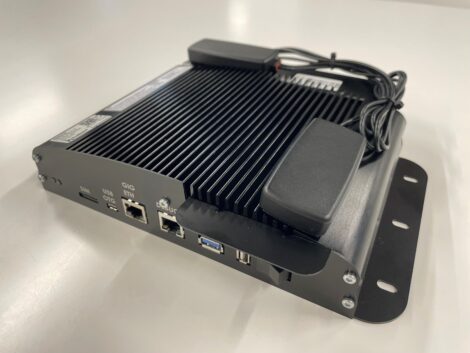
That is why Cognizant Mobility has also developed mobile measurement devices that can be used directly inside the vehicle. This enables HUD measurements under real-world conditions — with high positioning accuracy and a fully automated process.
The systems are easy to integrate, flexible to use and quick to deploy. This eliminates the need for complex, time-consuming in-vehicle measurement setups.
Windshield test bench: precision under laboratory conditions
In addition to mobile measurement systems, Cognizant Mobility also offers an innovative windshield test bench designed specifically for automotive pre-development.
The test bench combines robotics with a motorized, adjustable windshield mount. This allows the HUD to be precisely positioned and aligned under controlled laboratory conditions.

Optical parameters can be measured consistently across the entire windshield — from image alignment and color accuracy to distortion and ghosting effects.
The flexible windshield adjustment enables testing across different vehicle geometries, while robotic arms ensure that all measurements are performed fully automatically and with high precision.
Next-generation HUDs are more than just a display trend
Next-generation HUDs are a key component of future cockpit architectures — where information, navigation and entertainment increasingly converge.
To make this vision a reality, measurement and validation solutions need to be just as advanced as the technology itself.
Cognizant Mobility supports HUD development with automated test benches and mobile validation solutions — from early concept phases to series production.
Are you developing next-generation HUD systems?
Talk to our experts about innovative testing approaches for the next generation of head-up displays.